Another published article I can now share online. The full citation is:
Ruffner, Malissa. “Jim Wilson of Caroline County: Lynching Victim Reunited with His Family,” Maryland Genealogical Society Journal 64 (December 2023): 291–312.
Blog
Indirect Evidence Corrects the Parentage of Lemuel Offutt of Baltimore County, Maryland
Recently inspired by serendipitous turn of events—more on that later—I’m posting another published article, this, my one and only contribution to the National Genealogical Society Society Quarterly (NGSQ). I mentioned the article here, where I documented a postscript, so if you read this one, check out the P.S.
Malissa Ruffner, “Indirect Evidence Corrects the Parentage of Lemuel Offutt of Baltimore County, Maryland,” National Genealogical Society Quarterly 104 (December 2016): 267–82.
The Stauffers of Walkersville, Maryland
This is another published article I am now free to share more widely—a labor of love to honor my second cousin, once removed, Nancy Nicodemus Greenwood Franck (1926–1922) of Walkersville. Her mother, Ella Felisa, and my grandmother, Mary Ella, were first cousins, likely named for the same aunt. Nancy generously shared family data, photographs, artifacts, and stories, a collaboration we embraced at our first meeting in 2012. (Like the Wedding Dress that Nancy later donated to the Montgomery County Historical Society with my help.)
The yellow farmhouse that serves as a narrative focal point of the article is of special interest to me because my grandmother, and later my grandfather, visited it numerous times. Mary Offutt Ruffner is pictured on p. 23.
The article, originally published in the Maryland Genealogical Society Journal with different pagination, is here.
Citation for MGSJ:
Malissa Ruffner, “The Stauffers of Walkersville, Frederick County, Maryland,” Maryland Genealogical Society Journal 60 (2019): 365–430.
“Chief Contriver”
One of my first and thrilling discoveries at a life-changing week at New England Historic Genealogical Society’s “Come Home to New England” in 2009 was the discovery that my husband is descended from a notorious counterfeiter in the Massachusetts Bay Colony in the late 1600s and early 1700s. (Makes my family look pretty good.) I wrote about my week here and here.
Ultimately the line spawned by the outlaw became the basis of my Board for Certification of Genealogists portfolio’s Kinship Determination Project and was later published in the New Hampshire Record. The family settled down after that but the project remains a favorite because of the variety of materials consulted, the research travel it demanded, and how much I learned.
Here it is (as published in the New Hampshire Record) in 2018:
The Odells of Stratham, New Hampshire: An American Family Takes Root
Meet Emma D. Sudrow
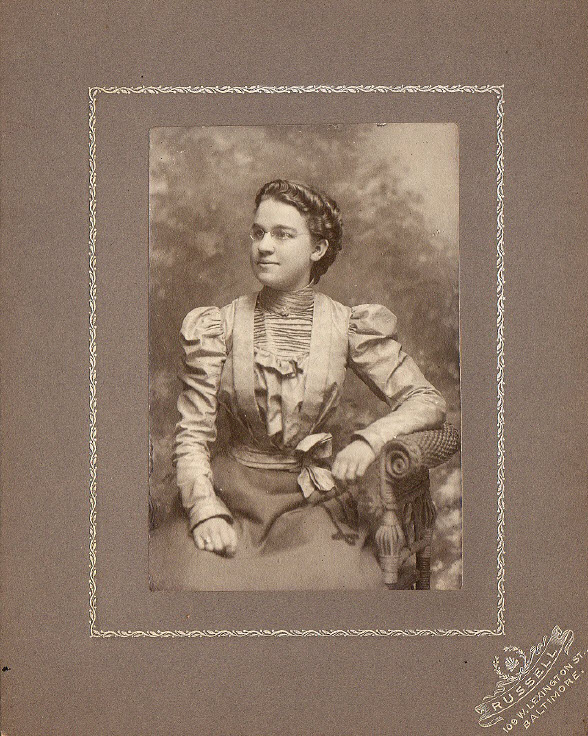
Emma D. Sudrow, MGS Photo Vault,
used with permission from the Maryland Genealogical Society.
Like most genealogists, I’m fascinated by old photographs. When they are unlabeled, you wish someone had taken a moment to record the names. (And you vow to do better yourself.)
The Maryland Genealogical Society holds a collection of photographs—mostly portraits—at its MGS Photo Vault webpage. Fortunately, many are labeled with names and dates but the personal stories behind the faces are largely unknown. I selected one portrait—Emma D. Sudrow—for closer study and was richly rewarded. Emma and her dear friend, Mary, took me on a fascinating research journey through Baltimore history, dotted by familiar names, places, and events.
Smalltimore: Emma D. Sudrow and Mary C. Monk of Baltimore City was published in the Maryland Genealogical Society Journal in 2022 and is reposted below. For me, studying individuals brings history alive. I hope you enjoy getting to know Emma and Mary, and through the lens of their personal stories, learn something new about Baltimore.
Full Citation: Maryland Genealogical Society Journal 63 (2022): 273–305.
Sarah Dukes Offutt: A blank filled in
I’m doing what all genealogists are supposed to do (but especially during a pandemic): going through my folders and dealing with “the stuff.” I hold a piece of paper, consider its evidentiary significance, its value as an artifact, verify that I recorded the content and citation in my database, and then let it go….
But I can’t let go of this yellow piece of paper with my circular notes, because it represents the last family history conversation I had with my father (JSR). We didn’t have many of them.
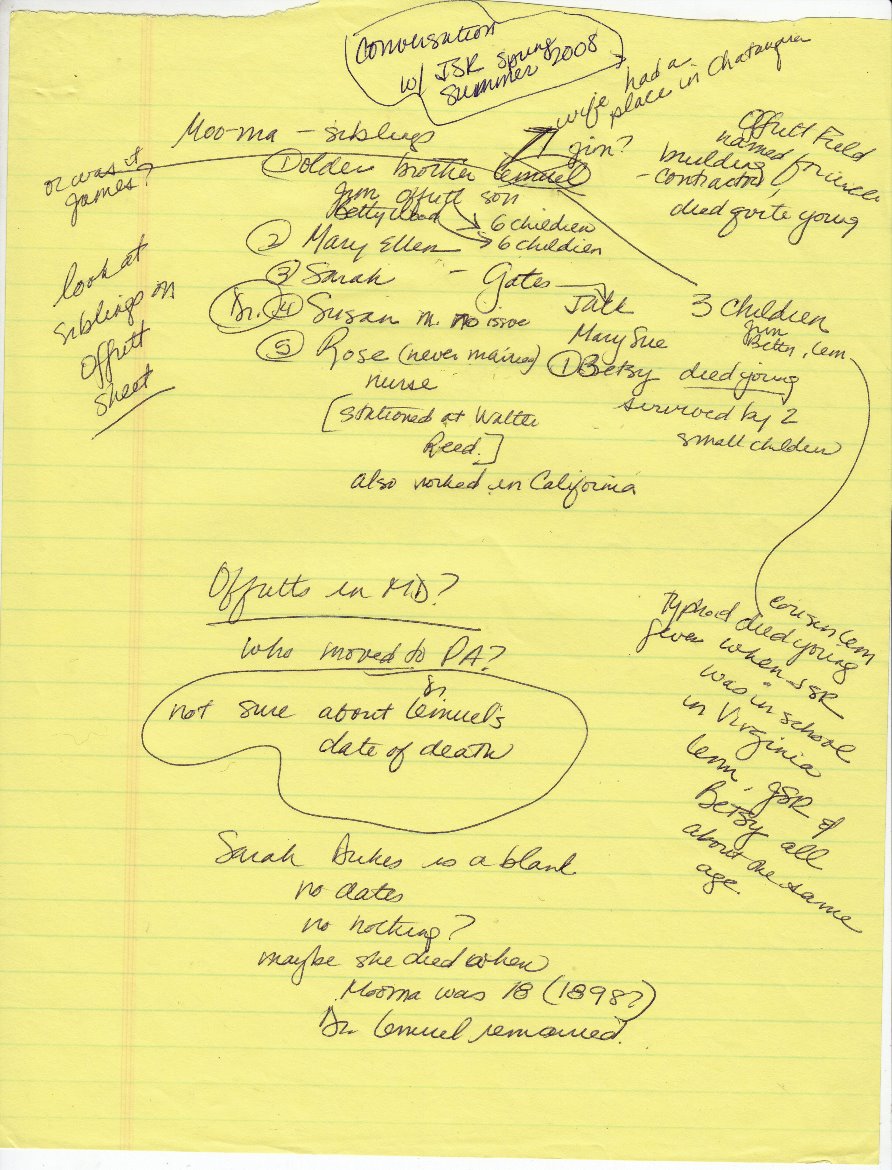
That summer of 2008, I scribbled, scratched, and drew arrows as he provided the names of the siblings of his mother, Mary Ella Offutt, my grandmother, Moo-ma. The names were familiar to me (and I had met cousins of my generation as a child) but we had never tackled the topic in a methodical fashion. He died just a few months later.
At the bottom, I recorded: “Sarah Dukes is a blank.” Then, apparently incredulous, I wrote “No dates, No nothing?” He thought perhaps Sarah had died when his mother was 18 but, other than that, nothing. (He was off by just two years.) The loss my grandmother experienced at age 20 and carried silently throughout her life, is unimaginable to me. But I can imagine now that she learned stoicism from her mother.
I had a picture of Sarah, taken right here in Baltimore in the late 1870s, at 1 North Gay Street. A face without a story.

That void launched a satisfying journey of family networking, on-site research, and sleuthing from my desk. The article that resulted was published in the Maryland Genealogical Society Journal in August 2017, the issue that was also my first as editor. Here’s how I put it in the teaser:
Little was known about Sarah, but researching her story offered a chance to visit nearby repositories and sites that figured in her life. Three cousins—one known and two “new”—shared family letters.
If you’d like to hear echoes of Sarah’s voice and learn about her unusual coming-of-age, you can download the article below. And now that I’ve scanned the scrap of legal pad paper, I should be able to let that go. Right?
Sierra Blanca, one last time
Back in my blogging days, no post got more unexpected attention than the one I did on Tom D Ellison, my mother’s first cousin. While I traveled to Texas with plans to meet him, others just happened across Tom in their West Texas travels, came home and googled him, and found my post. We all agreed: he was truly a remarkable man. Sadly, Tom passed away in December after spending his last months away from his beloved garage. But he returned there with an honor guard, before being laid to rest next to his beloved “Tootlehopper.”
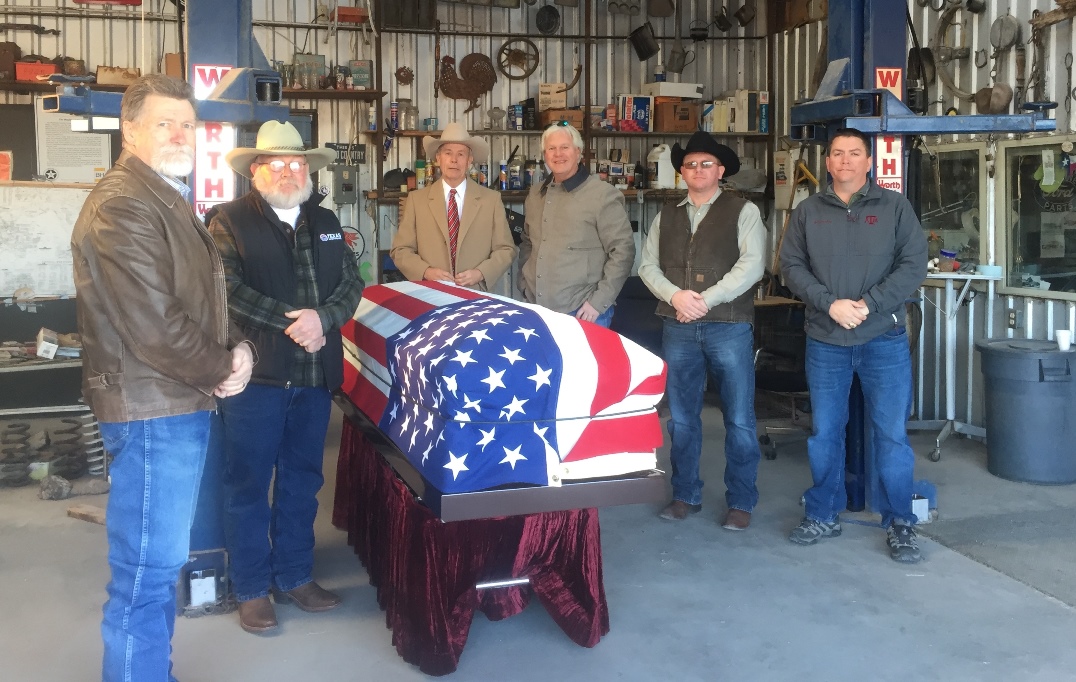
And now it’s time for one last hurrah in Sierra Blanca for the Williams family, who arrived there in 1911. On June 1st, Tom’s amazing collection of everything-you-can-imagine will be auctioned (after a tremendous amount of preparation work by his direct heirs). And a cluster of Williams descendants will be on hand to bear witness to the event. My first cousins and I have not seen each other in many years and I think Tom would be pleased that we will be there in solidarity with those whose job it is turn off the lights after a remarkable run.

For more information about the auction, because if you are within driving distance, you will want to be there: http://www.bradenauctions.com/JUNE1.html
Photos courtesy of Roger C. Ellison.
Anne Ruffner Edwards
 Anne Ruffner Edwards died at the Gosnell Memorial Hospice House in Scarborough, Maine, on December 24, 2018, after being diagnosed with brain cancer earlier in the month.
Born on August 29, 1945 in El Paso, Texas, she was the first daughter of James Stephens and Mary Elizabeth (Williams) Ruffner. She was raised in Aliquippa, Pennsylvania, and graduated from Aliquippa High School and Grove City College. She taught high school English in Akron, Ohio, and Carnegie, Pennsylvania, before her children were born. Later she earned an M.S. in Library Science and Information Systems from Clarion University of Pennsylvania.
While a librarian and part-time instructor at Clarion, Anne was selected to be part of the Career Renewal Project, a federally-funded program to help state college faculty and staff transition to “real world” employment. Anne was the “star participant,” said Don Drake, program director and longtime friend. She launched her career in higher education administration as the Director of Career and Student Services at the Carnegie Mellon University Heinz School for Public Policy and Management in Pittsburgh. She spotted an opportunity at the University of Chicago, where the public policy inter-departmental committee was becoming a degree-granting school, and informed the founding dean why he and the school needed her. Not immediately convinced, he listened to multiple pitches before relenting. She went on to serve as Assistant Dean at the Harris School of Public Policy from 1989 until 1993. From there, she moved to Washington, D.C., to become a senior associate at the National Academy of Public Administration for four years. That was followed by a visiting appointment at the University of North Carolina as Director of State and Local Policy Programs.
Anne worked as a freelance writer and editor, specializing in environment policy, economic development, and education for numerous organizations, including the Pew Charitable Trusts; University of Maine; Educational Testing Service; Carnegie Endowment for Peace; University of Maryland; Maine Development Foundation; and Maine Governor’s Commission on Health Care. She helped many Ph.D. candidates polish their dissertations; no doubt, she would have used her red pencil on this obituary to good effect.
Anne moved to Portland in 1998 to be near her children. She began working at the Portland Public Library as a reference librarian the following year, and was then hired at the University of Southern Maine as a reference, research, and instruction librarian. Sandy Shryock, a public library colleague, remembers her as “the type of reference librarian patrons hope they’ll meet—who knows the answer or where to track it down.” Anne once reflected “You gotta love a career that allows you to find out the color of Valerie Bertinelli’s hair and locate a feminist critique of Jerusalem’s Gate in one 20-minute period.” She also taught at the USM Muskie School of Public Policy and Lewiston-Auburn College, and later worked at the Casco Bay Estuary Partnership as an administrative assistant.
Along the way, Anne became fond of the Chicago White Sox and the Baltimore Orioles and, in Portland, enjoyed walking a few blocks to attend Sea Dogs games. Primarily, though, she waved her Pittsburgh black-and-gold sports loyalty with fierce determination. (At the same time, she wasn’t above flaunting her Texas roots.) While not a native of Maine, she fit right in. She had strong opinions, a sardonic wit, and was stoic and independent. She celebrated family occasions and friendships with flair and generosity.
She is survived by her children, Elizabeth Edwards, Kittery, Maine, and Stephen Edwards, Portland; her two sisters, Rebecca R. Lobato, Aurora, Colorado, and Malissa Ruffner, Baltimore, Maryland; her son-in-law, Steve Hickoff, and cherished granddaughter, Cora Hickoff, a junior at Carnegie Mellon University; her maternal uncle, Jerry L. Williams, of El Paso, Texas; and nieces, nephews, and a host of friends.
Anne donated her body to the University of New England. No services are planned. Memorial donations may be made to the ACLU of Maine, Planned Parenthood of Northern New England, or Maine Audubon. She would want us to keep up the good fight.
[A shorter version of this obituary appeared in the Portland Press Herald on 28 December 2018.]
The Rest of the Story

Lemuel Offutt of Baltimore County, the subject of my recently-published article is not our direct ancestor.[1] But he is the uncle of “our” Dr. Lemuel Offutt (pictured here with his oldest grandchildren), of Greensburg, Pennsylvania, who is likely named for him.
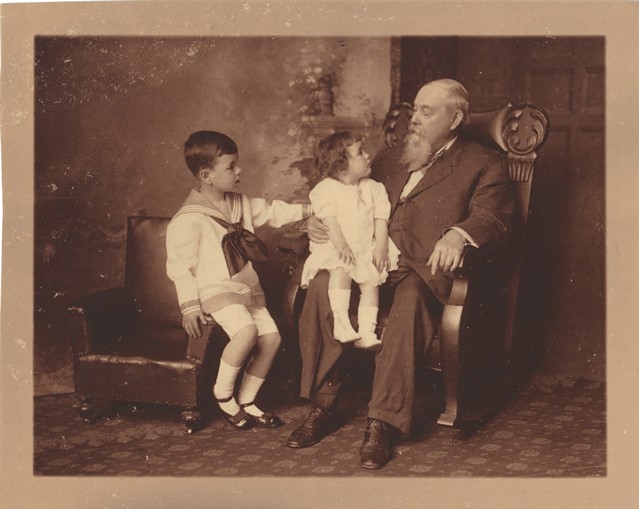
Uncle Lemuel of Baltimore County was the son of James Offutt of William and Rebecca Offutt, second cousins; James and Rebecca are our 3rd great grandparents. We are descended from Lemuel’s brother, James, whose financial difficulties are detailed on p. 277 of the article.
One section of the draft that did not make it to print will be of interest to those descended from Dr. Lemuel Offutt. The article reveals that Uncle Lemuel Offutt of Baltimore County (who had married into money) paid off the mortgage of his dying brother, James of Montgomery County, so the family could hold onto the Darnestown farm. After Lemuel of Baltimore died in 1865, his executors filed suit to recover the money from our still-broke family in Darnestown.[2] For a long time, our forebears got away with ignoring the suit. But when James’s widow, Mary, died in 1879, the plaintiffs’ compassion reached its limit.
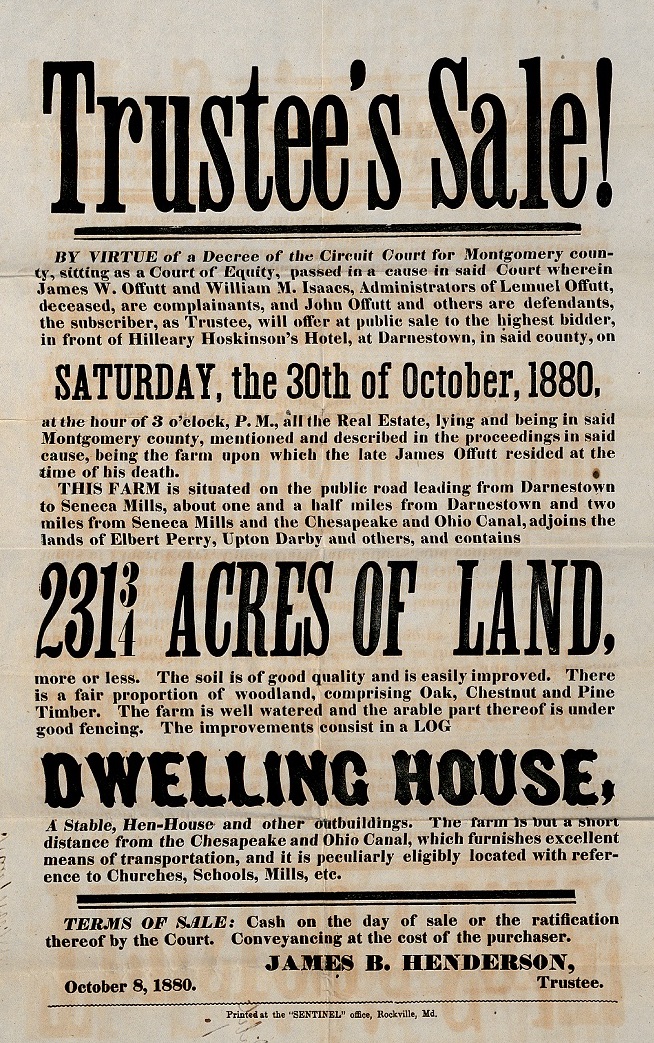
In 1880, our long-bearded Uncle Jim Offutt was forced to buy the family farm at a public auction.

He paid $2,108.[3] On the same day, Uncle Jim sold an undivided one-half interest in the property to Sadie Offutt, wife of his brother, Dr. Lemuel Offutt, for $1,054.[4]
The bottom line is that for two generations in a row, a younger brother named Lemuel helped an older brother named James hold onto family property.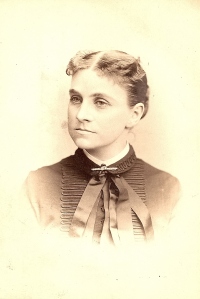
When Sadie Offutt died in 1905, her share of the Darnestown farm was inherited by her husband, son, and four daughters. Dr. Lemuel died in 1918, his share passing to his children. And, in 1919, they and their spouses sold their share of the farm back to Uncle Jim for $5,000[5]:
- James H. Offutt and Bess Conrow Offutt, of Greensburg, Westmoreland County, Pennsylvania
- Mary Offutt Ruffner and James A. C. Ruffner, of Beaver County, Pennsylvania
- Sarah Offutt Gates and J. Edward Gates, of Fairchance, Bedford County, Pennsylvania
- Susan R. Offutt, unmarried, and Rose E. Offutt, unmarried, of Westmoreland County, Pennsylvania
It’s no wonder our grandparents and great-aunts felt a strong connection to that beautiful farm.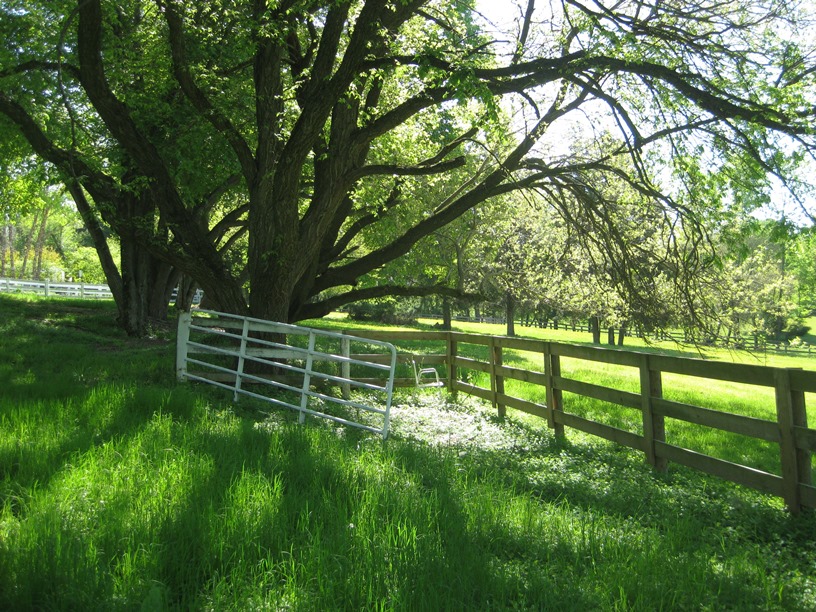
For a longer virtual visit to the Darnestown farm, click here.
[1] Malissa Ruffner, “Indirect Evidence Corrects the Parentage of Lemuel Offutt of Baltimore County, Maryland,” National Genealogical Society Quarterly 104 (December 2016): 267–82.
[2] Montgomery Co., Md., Circuit Court, Equity Papers, Case #128, Offutt et al. v. Offutt et al., Bill of Revivor, 23 June 1865.
[3] Montgomery Co., Md., Land Records, EBP 23:256, James B. Henderson, Trustee, of estate of Lemuel Offutt, to James H. Offutt, 30 November 1880.
[4] Montgomery Co., Md., Land Records, EBP 23:253, James H. Offutt to Sarah E. Offutt, 30 November 1880.
[5] Montgomery Co., Md., Land Records, PBR 278:247, James H. Offutt, et al., to James H. Offutt, 25 March 1919.
Grandma’s Cookies
Elizabeth W. (Biddy) Ruffner (Grandma) was a brilliant kitchen tactician who could feed an army during a week-long encampment. Family members at holiday celebrations and summer visits enjoyed a varied menu that emerged from her freezer(s) and cupboards.
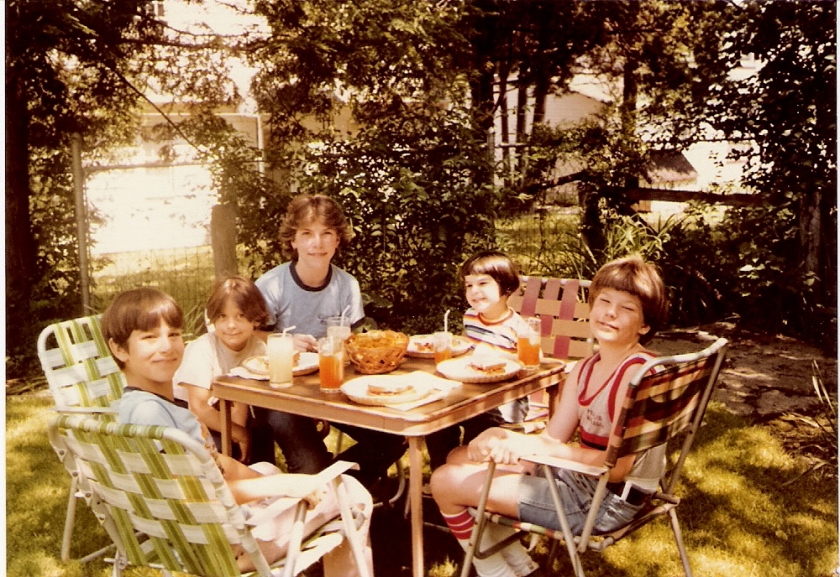
Not many women would host a backyard lunch for thirty guests on the day one of her daughters got married at 3:30 PM, but she did. And made it look easy.

But at no time were her skills more appreciated than during Christmas Cookie season. Starting in October (we think), she began the baking. Then, as the holiday drew near, the cookies were transferred to the “magic” closet, just beyond the door to the den, where the inefficient heating system rendered it cool enough to keep cookies fresh but not so cold they were frozen. Foil wrapping paper lined the inside of the louvered door, making a whoosh sound when you opened it. On the shelves were more than a dozen containers, each with a single variety, ready for the moment of replenishment. If you were lucky, it fell to you to go to the closet with the golden opportunity to weight the selection with your personal favorites.
The Christmas Cookie plate sat on the dining room table all day, and you couldn’t get anywhere in that house without passing through the dining room. Favorites named include snicker doodles, peanut butter blossoms, M&M cookies, Snappy Turtles, Pam’s Cookies (cream wafers), apricot bars, thumbprint cookies, peanut butter balls and Mexican Wedding Cakes
If Grandma’s Cookie Plate had been in use during the days of social media, no doubt we would have more pictures of it. This is only known picture, seen here in the foreground, with John and Clare in the background.
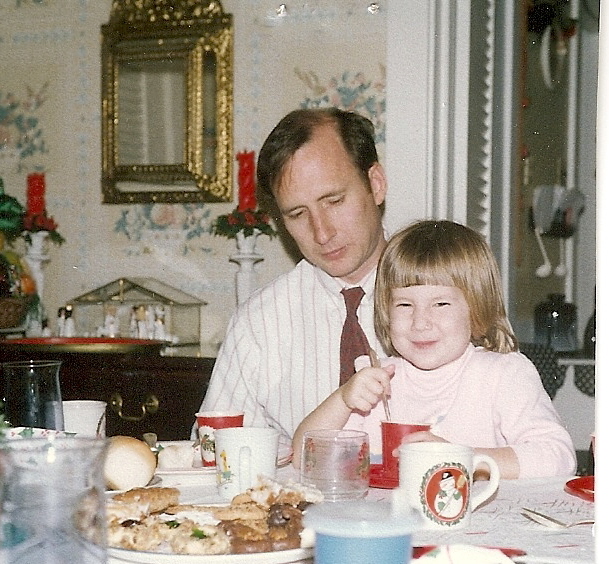
Cookie-baking wasn’t a group activity. But at least some of her granddaughters were schooled by the master. Elizabeth remembers that “we made snakes out of cookie dough then bent them into shapes like butterflies or flowers. And then we crushed different colored lollipops with a hammer and sprinkled the ‘stained glass’ inside the shapes and then baked them until the sugar melted into glass. Though not specifically for Christmas, the cookies were festive!” That must be what is happening in this picture taken in Baltimore.

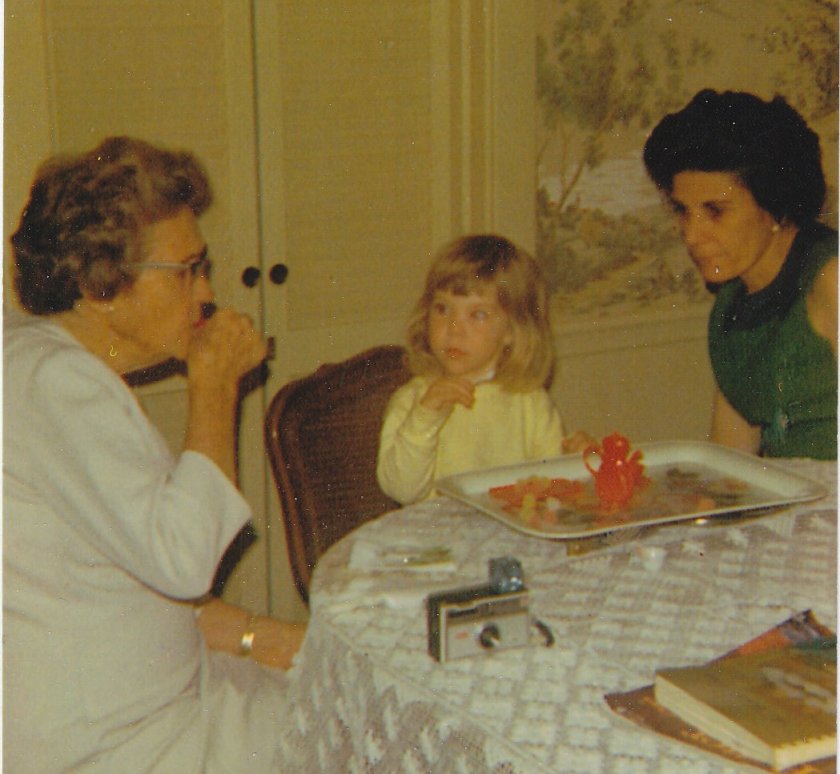
Her grandchildren also enjoyed her cookies and her rapt attention at tea parties. As Elizabeth recalled at her memorial service, she could sit down at a table with tiny dishes and turn a ten-minute visit into a very special occasion. Here she hosts her mother and Elizabeth at a three-generation celebration.
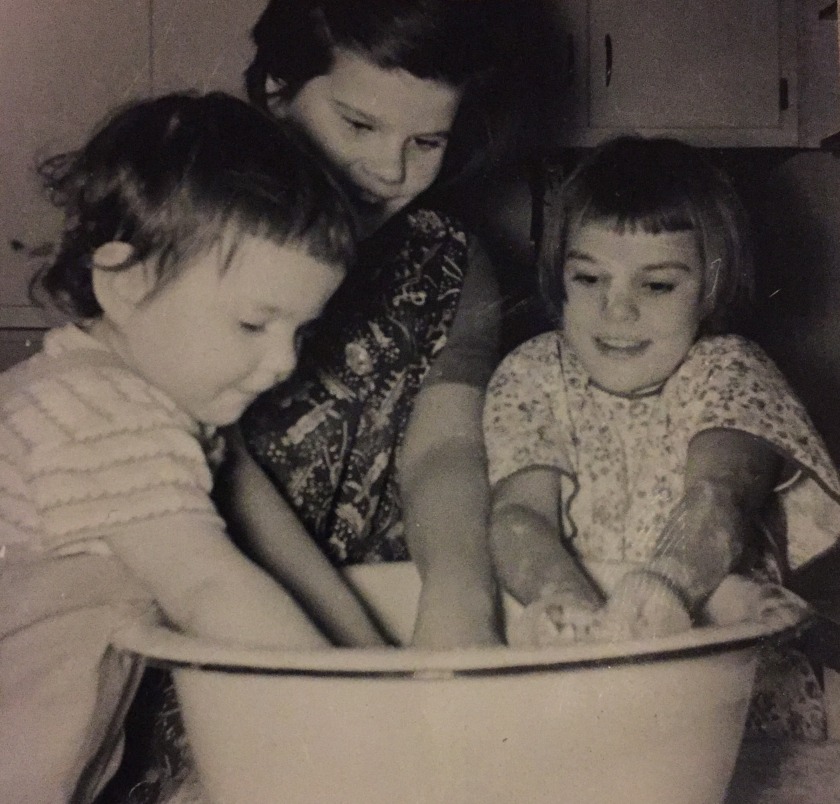
One activity did “require” the assistance of her daughters—the making of the Christmas fruitcake! Rebecca remembers the “flour and the mess we would make tossing the ingredients in the white baby tub.”
Grandma favored Fannie Farmer as her go-to cookbook but her personal collection of clippings and cards was stapled into garden club desk calendars and annotated with reviews and modifications. She used cross-references and citations to give credit where credit was due.
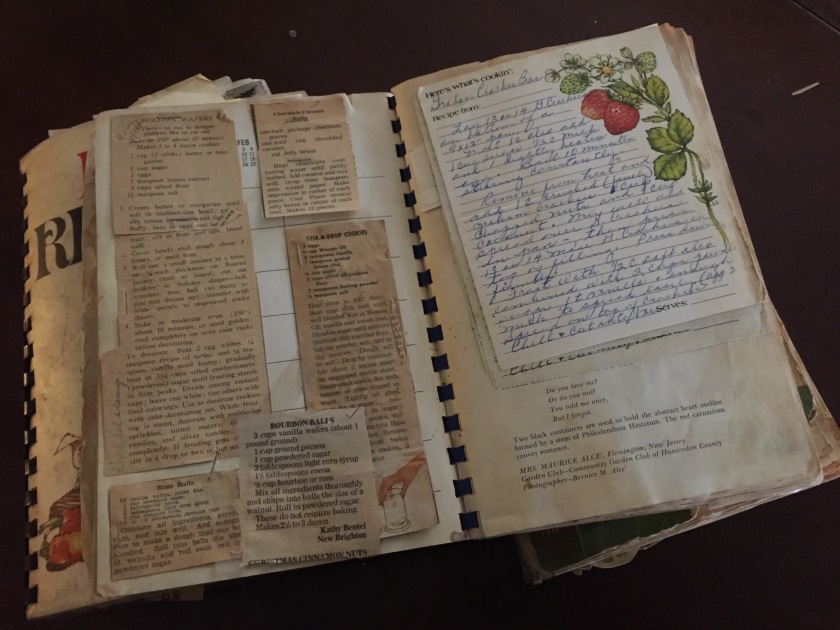
Her thoroughness was the hallmark of all that she did and that was so apparent at Christmas Cookie time. We who follow can only marvel at her talent—and capture a few memories in the kitchen.
 Family Epic